buddha machine.

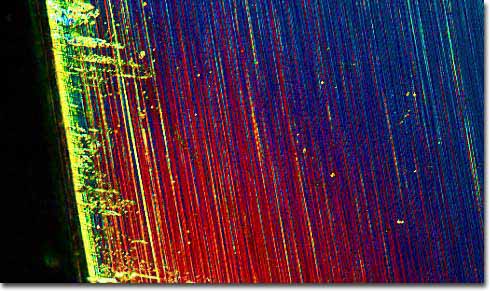
I purchased a buddhamachine last weekend.

buddhamachine

Created by FM3 (Christiaan Virant and Zhang Jian), this anti-ipod not only puts generates ambient loops (Brian Eno grabbed a bunch of them), it has a little Buddha in the machine. And it has another feature that I discovered this morning, by accident:

When a cellphone is ringing nearby, the drones become loud, distorted, and frenetic. I had plugged mine into the speakers in my bedroom into which I usually plug my iRiver I let the loops run, and then, as I was coming out of my shower, I heard something that sounded more like Autechre than like Eno. Sure enough, my cellphone was ringing. Likewise, when a text message is incoming, the unit buzzes.

I’m trying to put some sort of interpretive spin on it, but really, it’s just kind of cool.

Buddha on a phone

Ben Ruben and Mark Hanson – Listening Post

.flickr-photo { border: solid 2px #000000; }.flickr-yourcomment { }.flickr-frame { text-align: left; padding: 3px; }.flickr-caption { font-size: 0.8em; margin-top: 0px; }

One of the most engaging works I’ve ever lingered in front of was Mark Hansen and Ben Ruben’s Listening Post, which I saw at the Skirball Center about a year and a half ago (it was first shown in December 2001.) Hansen is a statistician; Ruben is an artist who works with sound and installations. The work organizes data culled from a range of chat channels throughout the internet onto a grid of index-card sized LCD screens, parsing them semantically in a fugue of investigations of simple phrases, run through a voice synthesizer and algorithmically generated into a composition. This sounds dry and experimental: however, when the system looks for every instance of a phrase that begins “i love” or “i am” and stitches them together, the effect is profoundly moving, an exploration of the mass sub-conscious of the Internet. I have rarely been as shaken by a new media work.

It reminds me somewhat of the opera of Robert Ashley, but I find it less solipsistic than Ashley’s work.

In their statement they elaborate on the process that they used. There are some videos that give a sense of the delicacy of feeling of the work.

I hope that it gets shown again soon – it deserves a permanent home.

From the 2005 Digra conference, a paper that I wish that I’d heared on a topic I wish I could have researched:  Kenji Ito writes about amateur-designed RPGs in Japan. (Both the abstract and the paper are available online.) Some of the amateur-designed games sound very compelling: stories about divorce, abuse, suicide and sexism created by amateurs using a commercially available game-design toolkit to describe their experiences.

These tools need to be use more – engines for narrative systems, embedding the economies of secrecy and revelation, of alliance and betrayal, of irrevocability and consequence, into narratives in a way that only a game system really can. (A game system contains the possible worlds of narrative – while it smuggles its own fictions in, it allows one to step back from novelistic fatalism and see a network of contingencies instead. “If this, then that – it need not have been this way, it could have been that way.”) This is the Boalian possibility of games that Gonzalo Frasca talks about.

This is only possible, however, among a community of amateur player-artists who are already literate with the techniques, methods and conventions of the computer RPG. The genre is already advanced and well-established in Japan (it could almost be called a national genre) – a developed syntax exists. It is from these fan-based practices, outside of the industry but derived from it, that many real aesthetic advances will come.

I met Professor Ito in Vancouver, and he told me that there was too little reading of the game-as-text or artifact in Japan; most analyses were either sociological or industry-focused. The games described in his paper are, apparently, available online.

Yes, it’s time to study some more kanji.

Continue reading

Palimpsest 4.

hard disk platter

What we think of as the material “real” of the computer – that is, the binary itself, the ones and zeros – is really a fiction. Depending on the media involved, the one or the zero is implemented as a level of relative difference in amplitude (in volatile memory) or magnetic charge (in storage). The material truth of a bit is still analog, continuous information (typically the difference between a charge of about .4 of charge capacity for a memory address and a charge of about .7 or so.)

In hard drives, the act of writing and rewriting leaves a bit of difference, a variance that can be decoded. In other words, if you write something to your hard drive that turns a bit to zero, and then turn it to 1, and then back to zero, there is actually a difference (in terms of the charge of the magnetic medium) between the first instance of “zero” and the second instance of “zero.”

It is a demanding and expensive process, but in theory, the slight differentials in the charges of the elements of the magnetic medium can be deciphered, and data that was over-written several times over recovered. There are practical limitations to this; however, while the fiction of the binary, of the pure 1 and the 0, is capable of instant oblivion, the gap between the material and the metaphor hides a surprising persistence of lost memory.

Palimpsest 4.

hard disk platter

What we think of as the material “real” of the computer – that is, the binary itself, the ones and zeros – is really a fiction. Depending on the media involved, the one or the zero is implemented as a level of relative difference in amplitude (in volatile memory) or magnetic charge (in storage). The material truth of a bit is still analog, continuous information (typically the difference between a charge of about .4 of charge capacity for a memory address and a charge of about .7 or so.)

In hard drives, the act of writing and rewriting leaves a bit of difference, a variance that can be decoded. In other words, if you write something to your hard drive that turns a bit to zero, and then turn it to 1, and then back to zero, there is actually a difference (in terms of the charge of the magnetic medium) between the first instance of “zero” and the second instance of “zero.”

It is a demanding and expensive process, but in theory, the slight differentials in the charges of the elements of the magnetic medium can be deciphered, and data that was over-written several times over recovered. There are practical limitations to this; however, while the fiction of the binary, of the pure 1 and the 0, is capable of instant oblivion, the gap between the material and the metaphor hides a surprising persistence of lost memory.

Palimpsest 3.

twombly, untitled 1970

Cy Twombly, Untitled, 1970

Overwriting is a different kind of oblivion – it is a kind of reluctant repression, the preservation of the sign in another mode. The earlier inscriptions are revealed by becoming forgetful of what is apparent-to-sight and looking at another level of sensation, becoming sensitive to finer and subtler levels of difference and ignoring the more obvious ones.

Palimpsest 3.

twombly, untitled 1970

Cy Twombly, Untitled, 1970

Overwriting is a different kind of oblivion – it is a kind of reluctant repression, the preservation of the sign in another mode. The earlier inscriptions are revealed by becoming forgetful of what is apparent-to-sight and looking at another level of sensation, becoming sensitive to finer and subtler levels of difference and ignoring the more obvious ones.